Rules, Not Rulers
How Fiat Currency Destroys Society. And How Bitcoin Redeems It.
From landed southern elite and northern industrialists in the early republic to Wall Street bankers, Beltway bureaucrats, and Silicon Valley coders today, policy in America is and has always been shaped by those with wealth, connections, and credentials.
And although the government remains formally “democratic”, in practice it is highly plutocratic. Ruled by the elite, for the elite.
Because in America, Wealth = Political Access.
From mega-donors and PACs to powerful lobbies and think tanks, the wealthy elite ultimately choose our politicians and, as a consequence, craft our legislation.
This is fine when the wealthy pursue policies that help everyone share in the abundance.
Unfortunately, though, for the past 50 or so odd years, policy decisions have disproportionately benefited the wealthy.
Wages haven’t kept pace with inflation. Housing, education, and health care have become far less affordable. And the gap between the haves and the have-nots continues to widen.
In his latest book, “End Times: Elites, Counter-Elites, and the Path of Political Disintegration,” Peter Turchin argues that today, due to elite overproduction and popular immiseration, the United States is nearing a societal breaking point.
In this article, we’ll look at the root cause of the problem: broken money.
We’ll examine numerous examples of how the elite have rigged the “money game” in their favor.
And finally, we’ll look at how a Bitcoin Standard will end the rigged game.
Because Bitcoin is a system of rules… not rulers.
It forces the wealthy elite to compete productively and honestly.
It protects the middle and lower classes from being strip-mined by inflation.
And it gives everyone in society money that can’t be debased, manipulated, or weaponized.
Broken Money - Elite Overproduction & Popular Immiseration.
Do you ever wonder… How many dollars exist? How are dollars created? Why can’t I create my own dollars? Why does a particular group of wealthy and connected bankers have the authority to create dollars?
All of these questions are easily answered once you understand Fiat currency.
Fiat currency is government-issued money declared as legal tender. Fiat currency’s value is wholly dependent on government stability and public trust.
Here, it is argued that through issuing far too much Fiat Currency, the elite class has broken public trust in institutions… which has led to our current chaotic political situation.
Fiat Currency is the principal cause of Elite Overproduction and Popular Immiseration.
Because, you see, for millennia, gold and silver served as money because they are honest.
Gold and Silver are scarce, durable, divisible, widely accepted, and extremely difficult to manipulate, counterfeit, or control.
For these reasons, the Founding Fathers established that only gold and silver were legal tender for the states.
Honest, “hard” money encourages savings, long-term investment, and honest pricing.
They allow for innovation and productivity gains to drive a natural free-market phenomenon… Price Deflation. (ie, lower prices for all)
But most importantly, they served as a check on the state and the financial elite, constraining speculative lending and wartime spending.
It is for this reason that bankers argued that gold and silver were inadequate.
Banks realized that the more they expanded credit, the wealthier they became.
This desire for greater wealth drove them to issue more “paper claims” for gold than gold that they had in the bank vault.
Banks were able to issue these paper claims because gold has a weakness. Verifiability.
Verifying exactly how much a bank holds requires physical inspection, weighing, and assaying. This process is slow, expensive, and often logistically impractical.
So people were left to “trust” that the bankers were good for the gold…
And when a bank’s solvency came into question and a rush of customers demanded their gold, the “paper gold” fraud was exposed… and the bank collapsed.
You see, greed is a natural human tendency. When banks became too greedy and lacked discipline, the free market humbled them.
Unfortunately, the common man lacked a transparent ledger to verify that banks were good for the gold they claimed to have, and as a consequence, the pain caused by the bank’s greed and lack of discipline was widespread.
Tired of being humbled by hard currency… the bankers decided to form a…
Banking Cartel
With the Federal Reserve Act of 1913, the Federal Government agreed to backstop the greed and lack of discipline.
Now, the biggest and most powerful banks were free to expand credit without fear of collapse… and knowing that if a collapse came, the taxpayer would be there to bail them out.
Gold reserves were centralized.
Paper currency was printed to back the gold.
And the creation of the Federal Reserve (an elite banking cartel) effectively formed a mechanism to prevent citizens from holding the banks accountable.
The establishment of the Federal Reserve marked the beginning of the erosion of sound money, setting the stage for FDR’s 1933 gold confiscation and, ultimately, Nixon’s closure of the gold window in 1971.
Since 1971, the wealth and influence of the elite class have surged, while the economic standing of the middle and lower classes has deteriorated.
The system is now 100% dependent on credit creation and central bank monetary expansion. (Fractional Reserve Banking) As a result, all currencies have collapsed in gold Terms.
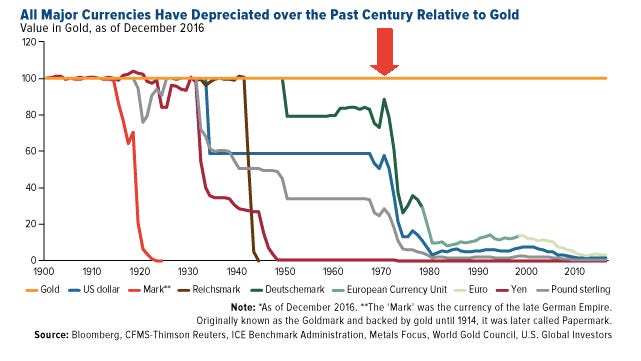
The consequences of this new system are profound.
Our Government debt has exploded.
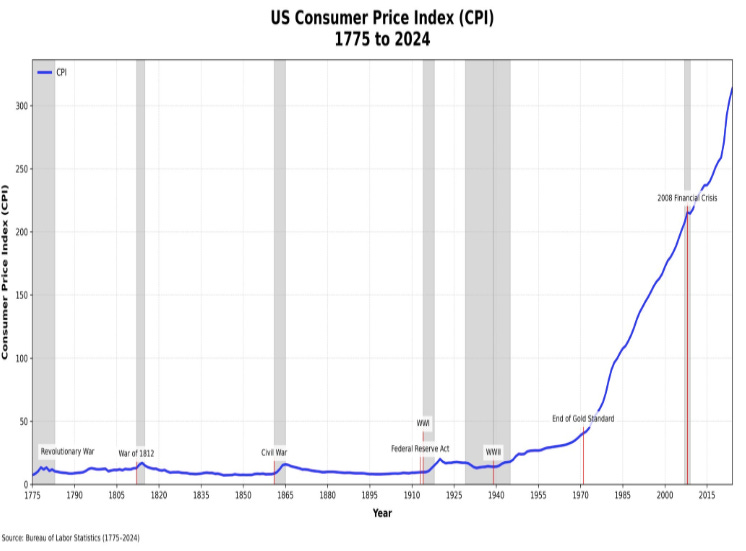
Wages for working- and middle-class Americans failed to keep up with rising prices.
Essentials such as food, energy, housing, healthcare, and education are becoming increasingly unaffordable.
And Inflation is suffocating the younger generations’ dreams of upward mobility.
So how, in this broken system, do the wealthy outpace inflation and continue to get wealthier, while the immiserated classes struggle to make ends meet?
The Cantillon Effect.
The Cantillon Effect describes the unfair system through which newly created (fiat) money enters the economy.
Because wealth = political access, the wealthy are able to dictate that, first and foremost, the money flows to themselves, thereby granting themselves disproportionate advantages in the economy.
In many cases, it is literally people at the top, voting themselves the money.
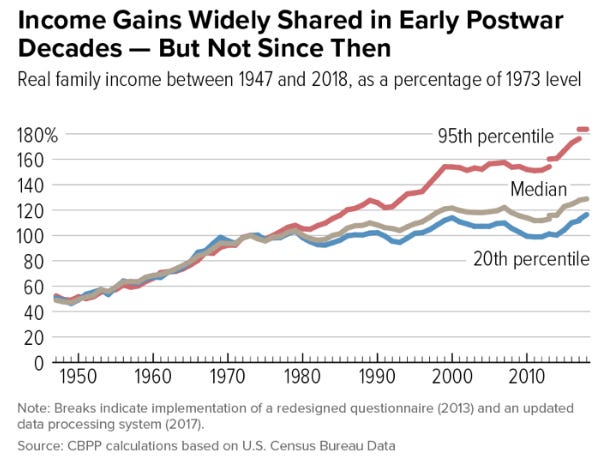
The Cantillon effect took off in 1971, the year Nixon severed the system's link to gold.
And the Cantillon Effect is the primary cause of Turchin’s Elite Overproduction. (The Effect is the Cause… I know it’s not supposed to work that way.)
Let’s take a look at some specific examples of how the Cantillon Effect works in practice.
Policies by Cantillionaires for Cantillionaires.
- During the Great Financial Crisis, while millions of homeowners faced foreclosure without relief, banks like Goldman Sachs, Citigroup, and Morgan Stanley lobbied for and received government bailouts funded by taxpayers. Literally, the banks got a bailout for the problem that they themselves created.
- In early 2020, four U.S. Senators, Richard Burr (R-NC), Kelly Loeffler (R-GA), Jim Inhofe (R-OK), and Dianne Feinstein (D-CA), after receiving private briefings about the extent to which the coronavirus would affect the economy, sold significant stock holdings just before the stock market collapsed. All this was done while publicly assuring Americans that the country was well-prepared. The trades drew fierce criticism and prompted ethics inquiries; however, no criminal charges were ultimately filed against any of the senators.
- Also, during the COVID era, two Federal Reserve presidents came under heavy scrutiny for their actions. Eric Rosengren and Robert Kaplan shamefully retired in September 2021 after it was revealed that they enriched themselves on the backs of the policies that they themselves authorized. Imagine being in control of printing more money (devaluing the money) and then choosing to reward yourself while others suffer the inflationary consequences of your decision.
- In the pharmaceutical arena, Pfizer, Moderna, and J&J received tens of billions in guaranteed government contracts. For what? Vaccines that didn’t prevent transmission? Vaccines that likely did far more harm than good? All while pharma executives cashed out hundreds of millions thanks to federal procurement deals. Millions of taxpayer dollars… finding their way into the pockets of the pharma elite, while the commoners suffer the negative consequences.
- But that abuse of power by pharma pales in comparison to the destruction wrought by the Opioid epidemic. From 1999 to 2019, nearly 500,000 opioid overdose deaths occurred in the U.S., which is curious, because from 1999 to 2018, the pharmaceutical industry spent over $4 billion on lobbying and campaign contributions… that’s more than the oil and defense lobby combined. Big Pharma used these lobbying dollars to weaken oversight and capture the regulators. Working and middle-class Americans bore the brunt of addiction, while executives, shareholders, and lobbyists in pharmaceutical companies raked in billions.
- Now let’s talk about the “Essential” vs. “Non-Essential” debate. In 2020, governments decided which businesses could operate and which couldn’t. Big-box stores owned by the Cantillionares (Walmart, Target, Home Depot, Costco, Amazon warehouses, etc.) stayed open. While small retailers, restaurants, gyms, and local shops were forced to close or severely limit operations. By mid-2021, while many small businesses were left on life support, the five largest retailers controlled over 50% of all retail sales in America.
- Finally, let’s talk about the Defense Sector (aka War Sector). They’ve made out handsomely over the past 25 years. It’s estimated that we’ve spent more than $8T on wars in the Middle East. And honestly, what do we have to show for it? One could argue that we’re far less safe today than we were prior to 9/11. All the while, defense contractor elite have pulled record profits year in and year out thanks to an ever-increasing defense (war) budget.
The moral of the story is always the same… When you give the wealthy and connected the ability to vote themselves the money… The wealthy grow wealthier, the political insiders become entrenched, and everyday families struggle with rising costs and falling trust.
Toward a System of Rules, not Rulers.
Bitcoin ends the Cantillon Effect.
You can’t vote yourself more Bitcoin.
You can’t print yourself more Bitcoin.
If you’re greedy and irresponsible, you won’t be bailed out by Bitcoin.
You see, Bitcoin is similar to gold and silver in its sound money principles.
But thanks to its public digital ledger, it is far more transparent.
And this transparency makes it resistant to the political capture that undermined gold and silver in the 19th–20th centuries.
It forces elites to compete honestly in the marketplace rather than through political connections.
By restoring sound money, Bitcoin dissolves the conditions of elite overproduction and popular immiseration that Peter Turchin warns about.
It forces discipline upon the government, restrains speculative excess, and ensures that the nation's prosperity benefits everyone rather than only a narrow class of Cantillionaire insiders.
In this way, Bitcoin does not just “fix the money”; it revives the original American promise: a republic where freedom, fairness, and opportunity belong to all, not just the powerful few.