From Crisis to Collapse

How the War in Iran Threatens the Collapse of the Farm Economy
We’re going to need a bigger bailout.
In the past year, we’ve looked at the farm crisis and also how community banks are on the brink.
Today, we’ll look at why the war with Iran (for Israel) is likely the first domino in a chain reaction that takes out those farmers, their banks, and presumably every state government dependent on the agricultural economy.
Then, we’ll look at the second-order effects of this increasingly likely economic collapse and how to best prepare yourself for the eventual “Big Print.”
Because, as Major General Smedley D. Butler famously said, war is a racket. And it’s a racket that “is conducted for the benefit of the very few, at the expense of the very many.”
What the Farmer is Up Against
Thanks to a global supply glut of soy, farmers in the Midwest have been struggling to make ends meet for a while.
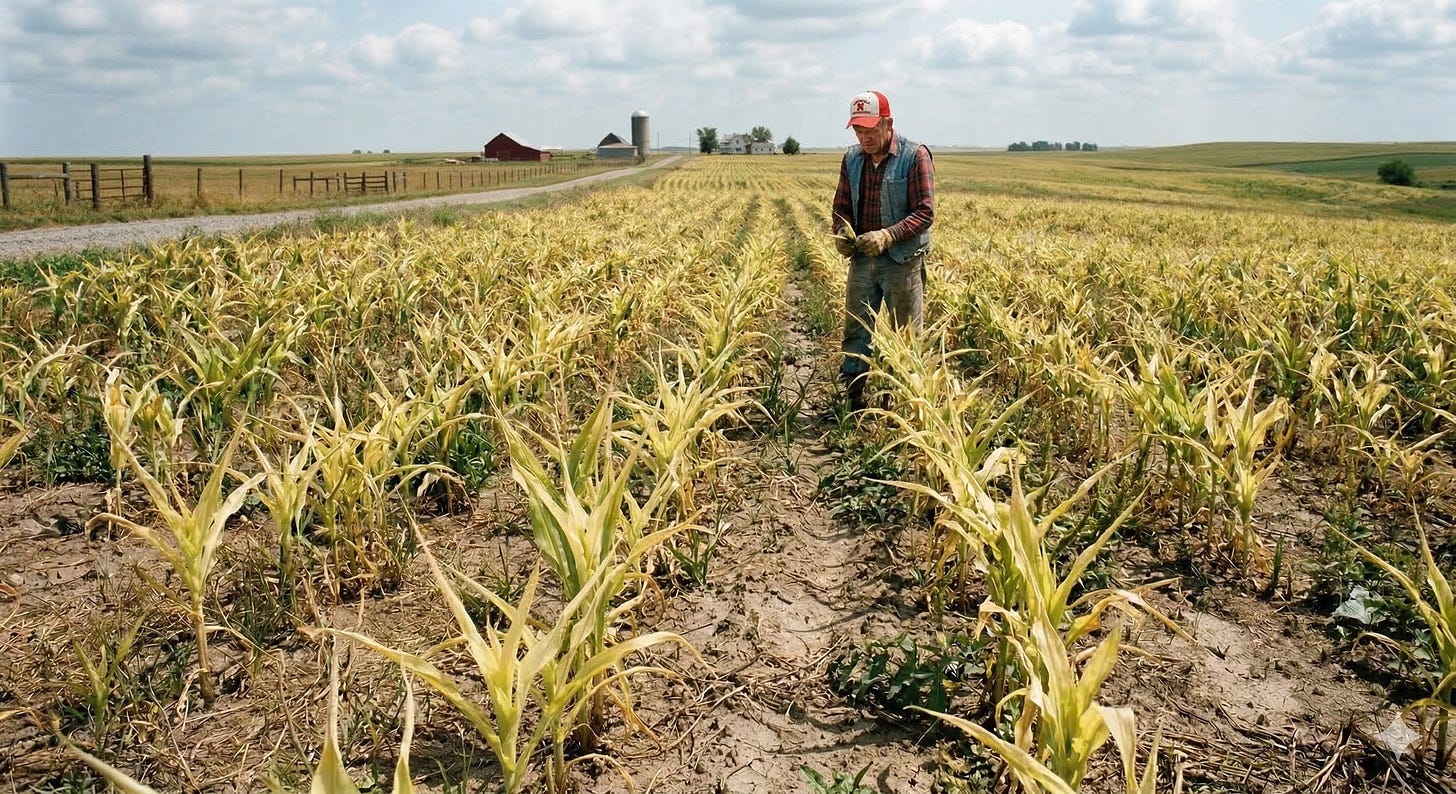
Now, with the onset of the war in Iran, running a profitable operation appears all but impossible because modern agriculture, particularly corn production, relies heavily on fossil fuels and their derivatives.
Not only do farmers rely on diesel to run the tractors, but they also rely on anhydrous ammonia, urea, monoammonium phosphate, diammonium phosphate, and potash to help their crops grow.
All of these inputs have seen material price increases since the closing of the Strait of Hormuz a few weeks back.
Just take a look at urea, which has nearly doubled over the past 3 months.
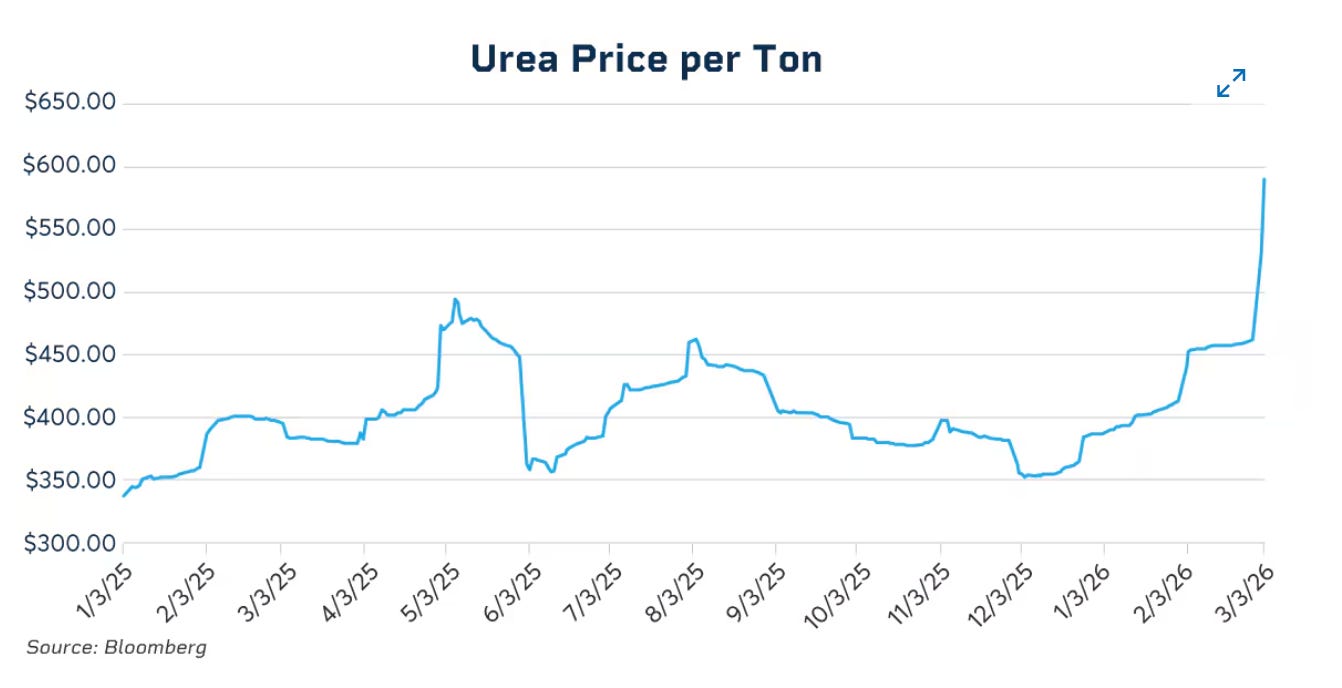
For context, prior to the war, a farmer in the Midwest would likely have spent ~$300 per acre to fertilize his corn and ~$80 per acre on his soybeans.
Now, with 30% of global fertilizer stock offline and no end to the war in sight, prices of those key fertilizer inputs appear likely to rise significantly further from here.
If input costs rise a further 50 or 100%… farming all but becomes a surefire way for the heartland to lose millions.
So let’s take a look at…
Why Farmers Won’t Break Even
One could hope for corn and soy prices to double or triple in order to keep pace with input cost inflation… But that’s highly unlikely given the aforementioned commodity supply glut.
Furthermore, the Trump administration has already signaled its unwillingness to tolerate rising food prices, having just a few months back signed an executive order to quadruple beef imports into the U.S. from Argentina. This action was taken to reduce beef prices, but it is likely to crush the already tight margins of domestic beef producers. (Nebraska is the Beef State.)
Thinking that he’d allow supply and demand to find a balance and, as a consequence, grocery bills to soar in an election year, is nonsensical…
So with that aside, let’s talk about the consequences of this war on the farm economy. Because if history is our guide, things could get really ugly here in the near term.
History of Farm Crises
During the Dust Bowl of the 1930s, roughly 750,000 farms, or 20% of all American farms, were lost through foreclosure, forced sale, or abandonment. At its peak in 1932, approximately 5,000 farms nationally went into foreclosure per month.
Then again, fifty years later, a similar crisis was seen.
Between 1981 and 1987, approximately 300,000–400,000 commercial farms filed for bankruptcy… which was roughly 15–18% of all farm operations at the time (1). Furthermore, many families were able to avoid bankruptcy but sold the farm at a loss… as it’s estimated that 50% of families that owned a farm in 1982 left the profession completely. (2)
So what happens today if 15-30% of farmers file for…
Bankruptcy
Today, just like the '30s and '80s… Farmers are likely to receive a massive government bailout. But before I get to that, let’s look at what might force this bailout to happen.
If large swaths of farmers in Nebraska, Iowa, Kansas, South Dakota, and North Dakota face foreclosure, the economy of those states will be in for a world of hurt.
Collectively, they’re home to hundreds of community banks and numerous agriculture-related industries that employ thousands. As high as 85% of the loans made by community banks in those states are agricultural loans, giving you a sense of the agricultural industry's economic footprint in these states. (3)
And the thing about these agricultural loans is that they are often secured or supported by the value of the farmland. Which historically has been great… as the price of said farmland tends to go up and to the right over time… But as input costs spike and as farm profitability evaporates, those farmland values are likely to take a massive hit.
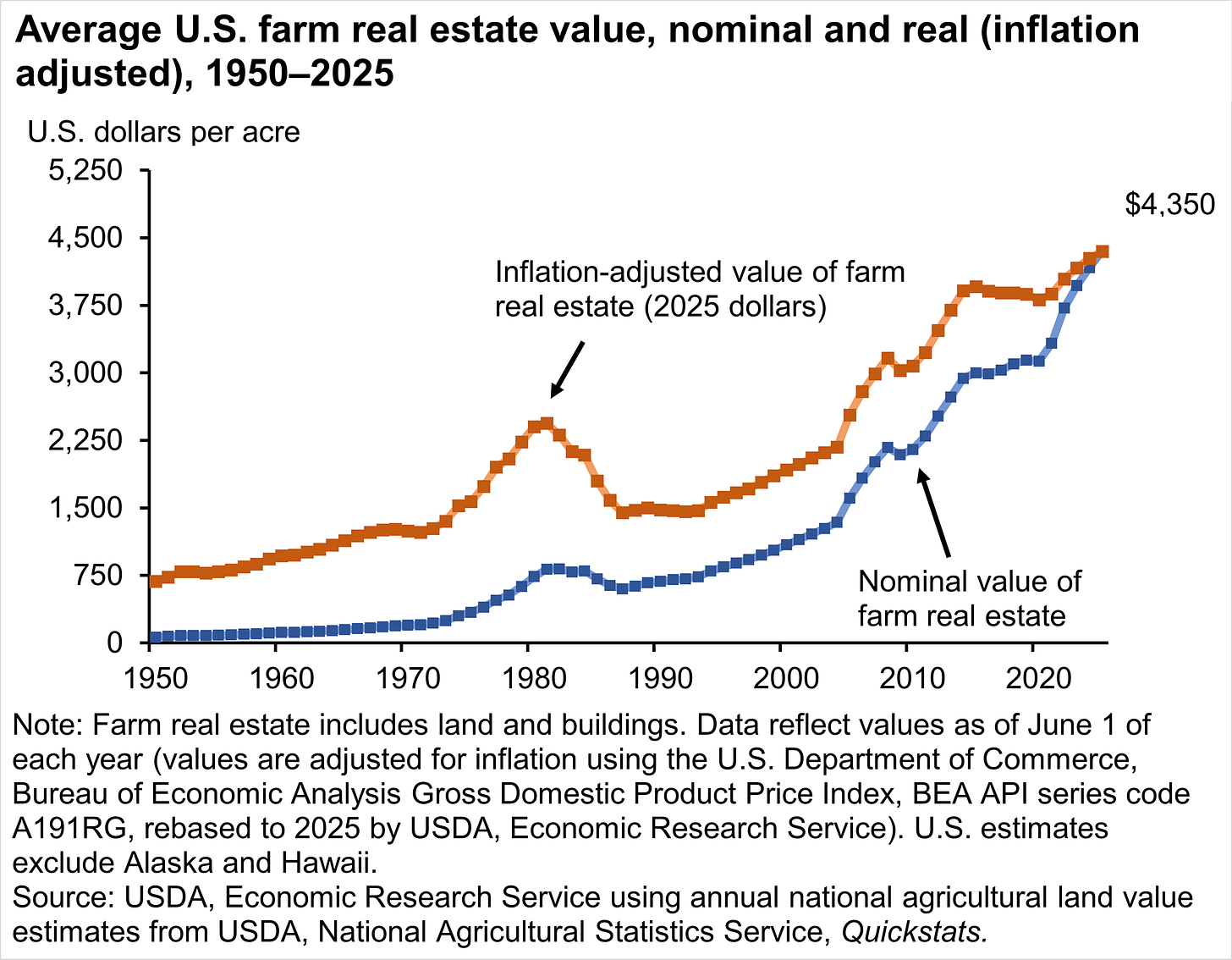
Imagine a 30-50% correction in farmland values, taking us back to $2500 per acre.
Almost every agricultural loan at these community banks would be significantly underwater… and with no way to swim up for air.
Still worse yet, when these farmland values take a hit… So too do rural school districts, which depend on tax revenue from said farmland.
Next on the chopping block is funding for law enforcement, fire departments, county infrastructure, and the like. Every cog in the machine starts to malfunction, because it’s all dependent on farmland values…
And as community banks lose their main depositor (farmers), whatever remains of their deposit base has little choice but to flee these community banks in droves for the likes of Wells Fargo, JPMorgan Chase, and other too-big-to-fail banks.
However, the greatest pain will likely be felt by the state government. If you think that the Nebraska State government's financial situation is poor now, $646M in the hole, just wait until the farming economy collapses, and that deficit pushes north of $1B… on its way to $2B.
To balance the budget, the state would be staring down the barrel of significant rural school consolidation, massive cuts to the university system, the closure of dozens of rural hospitals, a reduction in law enforcement, and on down the line we go…
Tell me again how Nebraskans benefit from a war with Iran?
The Big Print
Which brings us to the bailout. To avoid widespread bankruptcies and a collapse of the farm economy, the federal government will be forced to step in and print the difference. Farmers will farm at a loss, and the state governments will beg for as much welfare as the feds can muster.
Everyone will remain nominally whole… but the currency's purchasing power will depreciate at an accelerated rate.
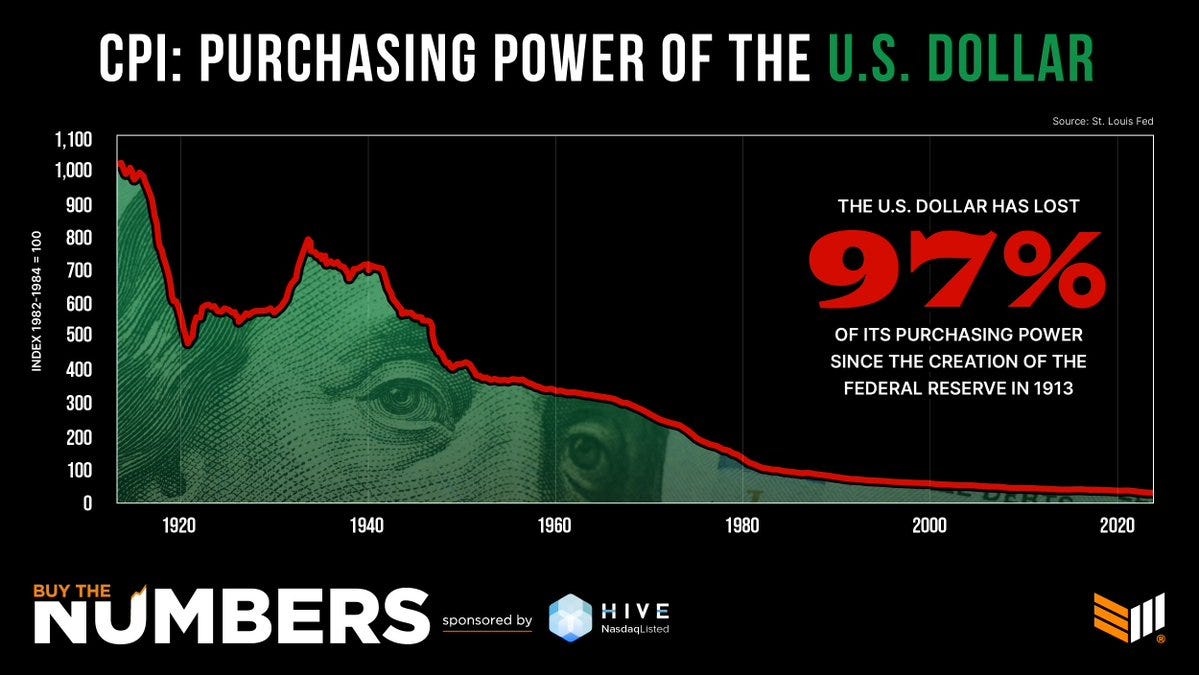
It’s the tried-and-true… rob Peter to pay Paul scenario.
Farmers and state governments will exist evermore as serfs, dependent on the federal government to make ends meet, which will be harder and harder to do as another war drives the nation further and further down the debt death spiral…
And during this death spiral, expect every constituency, not just farmers, to be looking for a handout… because war is inflationary and radical politics are a consequence of inflation…
So if you’re one of those people looking to build a world free from the radical politics of inflation… Bitcoin is for you.
If you’re one of those people who doesn’t want to work for money that another man/woman can print… Bitcoin is for you.
And if you’re one of those people who want to make wars in far-off lands unaffordable… Bitcoin is for you.
Until Next Time! ✌️
(1) U.S. Department of Commerce, Bureau of the Census, Census of Agriculture (1982 and 1987 editions), Volume 1: Geographic Area Series.
(2) Bruce Johnson and Vernon Sorenson, “Nebraska Agriculture in the 1980s: The Decade of Disruption,” University of Nebraska-Lincoln Agricultural Economics Staff Paper (1991).
(3) Kansas City Fed, "Agricultural Lending Concentration and Bank Performance," Economic Review, Vol. 108, No. 3 (2023).